
Ribonukleotide
Ribonukleotide sind die Bausteine der Ribonukleinsäure (RNA). Zusammen mit den Desoxyribonukleotiden gehören sie zu den Nukleotiden. Ribonukleotide bestehen aus einem Nukleosid, in dem der Zucker D-Ribose mit einer der Nukleobasen – wie den Purin-Basen Adenin (A) und Guanin (G) oder den Pyrimidin-Basen Cytosin (C), Uracil (U) und selten Thymin (T) – verknüpft ist, sowie einem Phosphatrest.
Monophosphate
In der Lebensmittelindustrie werden Mischungen von Ribonukleotiden mit einer Phosphatgruppe (Nukleosidmonophosphate, NMP) als Geschmacksverstärker verwendet und als Calcium-5′-ribonucleotid (E 634), Dinatrium-5′-ribonucleotid (E 635) deklariert:
 Adenosinmonophosphat
(AMP) Guanosinmonophosphat
(GMP) Cytidinmonophosphat
(CMP) Uridinmonophosphat
(UMP)
Diphosphate
Die natürlichen Nukleosiddiphosphate (NDP) sind:
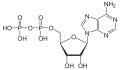 Adenosindiphosphat
(ADP) Guanosindiphosphat
(GDP) Cytidindiphosphat
(CDP)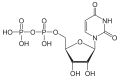 Uridindiphosphat
(UDP)
Triphosphate
Die natürlichen Nukleosidtriphosphate (NTP) sind:
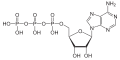 Adenosintriphosphat
(ATP)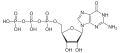 Guanosintriphosphat
(GTP)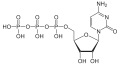 Cytidintriphosphat
(CTP)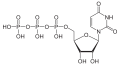 Uridintriphosphat
(UTP)
Vorkommen
Ribonuklotidmonophosphate in Lebensmitteln
| Lebensmittel tierischen Ursprungs | IMP Massenanteil in % | GMP Massenanteil in % | AMP Massenanteil in % |
|---|---|---|---|
| Rindfleisch | 0,070[1] | 0,004[1] | 0,008[1] |
| Schweinefleisch | 0,200[1] | 0,002[1] | 0,009[1] |
| Hühnerfleisch | 0,201[1] | 0,005[1] | 0,013[1] |
| Muttermilch | 0,0003[2] | unbekannt[2] | unbekannt[2] |
| Kalmar | unbekannt[1] | unbekannt[1] | 0,184[1] |
| Thunfisch | 0,286[1] | unbekannt[1] | 0,006[1] |
| Lachs | 0,154[2] | Spuren[2] | 0,006[2] |
| Kabeljau | 0,044[2] | unbekannt[2] | 0,023[2] |
| Makrele | 0,215[2] | Spuren[2] | 0,006[2] |
| Jakobsmuschel | unbekannt[1] | unbekannt[1] | 0,172[1] |
| Hummer | Spuren[2] | Spuren[2] | 0,082[2] |
| Garnele | 0,092[2] | Spuren[2] | 0,087[2] |
| Krabbe | 0,005[2] | 0,005[2] | 0,032[2] |
| Anchovi | 0,300[2] | 0,005[2] | unbekannt[2] |
| Sardine | 0,193[2] | unbekannt[2] | 0,006[2] |
| Seeigel | 0,002[2] | 0,002[2] | 0,010[2] |
| Lebensmittel pflanzlichen oder pilzigen Ursprungs | IMP Massenanteil in % | GMP Massenanteil in % | AMP Massenanteil in % |
|---|---|---|---|
| Tomate | unbekannt[1] | unbekannt[1] | 0,021[1] |
| Tomate, getrocknet | Spuren[2] | 0,010[2] | unbekannt[2] |
| Kartoffel, gekocht | Spuren[2] | 0,002[2] | 0,004[2] |
| Erbse | unbekannt[1] | unbekannt[1] | 0,002[1] |
| Spargel, grün | Spuren[2] | Spuren[2] | 0,004[2] |
| Nori | 0,009[2] | 0,005[2] | 0,052[2] |
| Shiitake, getrocknet | unbekannt[1] | 0,150[1] | unbekannt[1] |
| Steinpilz, getrocknet | unbekannt[1] | 0,010[1] | unbekannt[1] |
| Austernpilz, getrocknet | unbekannt[1] | 0,010[1] | unbekannt[1] |
| Morchel, getrocknet | unbekannt[1] | 0,040[1] | unbekannt[1] |
| Enoki | unbekannt[2] | 0,022[2] | unbekannt[2] |
Einzelnachweise
- ↑ a b c d e f g h i j k l m n o p q r s t u v w x y z aa ab ac ad ae af ag ah ai aj Shizuko Yamaguchi, Kumiko Ninomiya: Umami and Food Palatability. In: The Journal of Nutrition. 130, 2000, S. 921S–926S, doi:10.1093/jn/130.4.921S.
- ↑ a b c d e f g h i j k l m n o p q r s t u v w x y z aa ab ac ad ae af ag ah ai aj ak al am an ao ap aq ar as Ole G. Mouritsen, Klavs Styrbæk: Umami. Columbia University Press, 2014, ISBN 978-0-231-16890-8. S. 226–231.
Literatur
- Jeremy M. Berg, John L. Tymoczko, Lubert Stryer: Biochemie, 6. Auflage, Spektrum Akademischer Verlag, Heidelberg 2007, ISBN 978-3-8274-1800-5.
- Donald Voet, Judith G. Voet: Biochemistry, 3. Auflage, John Wiley & Sons, New York 2004, ISBN 0-471-19350-X.
- Bruce Alberts, Alexander Johnson, Peter Walter, Julian Lewis, Martin Raff, Keith Roberts: Molecular Biology of the Cell, 5. Auflage, Taylor & Francis 2007, ISBN 978-0-8153-4106-2.
Auf dieser Seite verwendete Medien

Cytidintriphosphat protoniert.svg
Struktur von Cytidintriphosphat
Struktur von Cytidintriphosphat

Guanosindiphosphat protoniert.svg
Struktur von Guanosindiphosphat
Struktur von Guanosindiphosphat

Adenosindiphosphat protoniert.svg
Struktur von Adenosindiphosphat
Struktur von Adenosindiphosphat

Uridintriphosphat protoniert.svg
Struktur von Uridintriphosphat
Struktur von Uridintriphosphat

Uridindiphosphat protoniert.svg
Struktur von Uridindiphosphat
Struktur von Uridindiphosphat

Cytidinmonophosphat protoniert.svg
Struktur von Cytidinmonophosphat
Struktur von Cytidinmonophosphat

Uridinmonophosphat protoniert.svg
Struktur von Uridinmonophosphat
Struktur von Uridinmonophosphat

Adenosintriphosphat protoniert.svg
Struktur von Adenosintriphosphat (ATP), protonierte Form
Struktur von Adenosintriphosphat (ATP), protonierte Form

Guanosinmonophosphat protoniert.svg
Struktur von Guanosinmonophosphat
Struktur von Guanosinmonophosphat

Guanosintriphosphat protoniert.svg
Struktur von Guanosintriphosphat
Struktur von Guanosintriphosphat

Cytidindiphosphat protoniert.svg
Struktur von Cytidindiphosphat
Struktur von Cytidindiphosphat

Adenosinmonophosphat protoniert.svg
Struktur von Adenosinmonophosphat
Struktur von Adenosinmonophosphat