

 NGC 5727
Galaxie im Sternbild Bärenhüter
NGC 5633
| Galaxie NGC 5633 | |
|---|---|
 | |
| SDSS-Aufnahme | |
| AladinLite | |
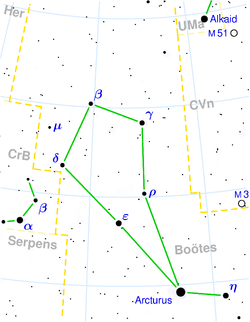
| Sternbild | Bärenhüter |
| Position Äquinoktium: J2000.0, Epoche: J2000.0 | |
| Rektaszension | 14h 27m 28,4s[1] |
| Deklination | +46° 08′ 48″[1] |
| Erscheinungsbild | |
| Morphologischer Typ | (R)SA(rs)b[1] |
| Helligkeit (visuell) | 12,2 mag[2] |
| Helligkeit (B-Band) | 13,0 mag[2] |
| Winkelausdehnung | 2,1′ × 1,1′[2] |
| Positionswinkel | 10°[2] |
| Flächenhelligkeit | 13,0 mag/arcmin²[2] |
| Physikalische Daten | |
| Rotverschiebung | 0.007785 ±0.000020[1] |
| Radialgeschwindigkeit | 2334 ±6 km/s[1] |
| Hubbledistanz vrad / H0 | (109 ± 8) · 106 Lj (33,5 ± 2,3) Mpc [1] |
| Geschichte | |
| Entdeckung | Wilhelm Herschel |
| Entdeckungsdatum | 11. Mai 1787 |
| Katalogbezeichnungen | |
| NGC 5633 • UGC 9271 • PGC 51620 • CGCG 247-030 • MCG +08-26-34 • IRAS 14255+4622 • GC 3899 • H I 185 • h 1818 • LDCE 1062 NED001 | |
NGC 5633 ist eine 12,2 mag helle Spiralgalaxie mit ausgeprägten Emissionslinien vom Hubble-Typ Sb im Sternbild Bärenhüter und etwa 109 Millionen Lichtjahre von der Milchstraße entfernt.
Sie wurde am 11. Mai 1787 von Wilhelm Herschel mit einem 18,7-Zoll-Spiegelteleskop entdeckt,[3] der sie dabei mit „c or pB, S, R, psmbM“[4] beschrieb.
Weblinks
- NGC 5633. SIMBAD, abgerufen am 20. März 2016 (englisch).
- NGC 5633. DSO Browser, abgerufen am 20. März 2016 (englisch).
Einzelnachweise
NGC 5727
Galaxie im Sternbild Bärenhüter
 NGC 5937
Galaxie im Sternbild Schlange
NGC 5656
Galaxie
 NGC 5743
Galaxie
 NGC 5681
Galaxie im Sternbild Bärenhüter
NGC 5623
Galaxie im Sternbild Bärenhüter
 NGC 5768
Galaxie
NGC 5622
Galaxie
Auf dieser Seite verwendete Medien

NGC5633 - SDSS DR14.jpg
Autor/Urheber: Sloan Digital Sky Survey, Lizenz: CC BY 4.0
The sky image is obtained by Sloan Digital Sky Survey, DR14 with SciServer.
Autor/Urheber: Sloan Digital Sky Survey, Lizenz: CC BY 4.0
The sky image is obtained by Sloan Digital Sky Survey, DR14 with SciServer.


Angle of view: 4' × 4' (0.3" per pixel), north is up.
Details on the image processing pipeline: https://www.sdss.org/dr14/imaging/jpg-images-on-skyserver/