KV15
| KV15 Grabmal von Sethos II. | |
|---|---|
| Ort | Tal der Könige |
| Entdeckungsdatum | im Altertum |
| Ausgrabung | Howard Carter |
| Vorheriges KV14 | Folgendes KV16 |
Das altägyptische Grabmal KV15 liegt im Tal der Könige. Dabei handelt es sich um das Grab von Sethos II., einem Pharao der 19. Dynastie.[1] Es ist seit der Antike offen. Der Gang ist dekoriert und die Grabkammer hat vier Pfeiler. Howard Carter erforschte es 1903 und 1904. In der Kammer gibt es 59 Wanddekorationen. Sie wurden 1889 von Eugène Lefébure abgezeichnet.[2]
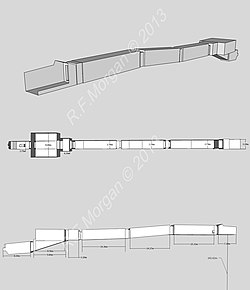 3D-Modell des Grabmals
 (c) Tobeytravels, CC BY-SA 2.0Wandrelief in KV15
 (c) Tobeytravels, CC BY-SA 2.0Wandrelief in KV15; Sethos II. bringt eine Opfergabe zu Osiris
 (c) Tobeytravels, CC BY-SA 2.0Wandrelief in KV15; geflügelte Gottheit Maat
Siehe auch
Literatur
- Erik Hornung: Das Tal der Könige. Beck, München 2002, ISBN 3-406-47995-2.
- Nicholas Reeves, Richard H. Wilkinson: Das Tal der Könige. Geheimnisvolles Totenreich der Pharaonen. Bechtermünz, Augsburg 2000, ISBN 3-8289-0739-3, S. 152–153.
Weblinks

Belege
- ↑ Ausgrabungen im Tal der Könige: KV 15, Sethos II (19. Dynastie) (Beschreibung)
- ↑ Ausgrabungen im Tal der Könige: KV 15, Sethos II (19. Dynastie) (Geschichte der Tätigkeiten im Grab)
Auf dieser Seite verwendete Medien
.png)
Sketch Map of East Valley of the Kings.
Original version taken from Egyptian Antiquities in The Nile Valley, published in 1932, by James Baikie (1866-1931). Taken from the english Wikipedia [1] Modified to show location of KV63. Topographgic lines added
For the correct locations of all graves on the map please see de:Template:Tal der Könige (Ost)![[1]](https://en.wikipedia.org/wiki/Image:East_Valley_of_the_Kings_Sketch_Map.jpg)

(c) Tobeytravels, CC BY-SA 2.0
Wall reliefs from the burial chamber of Tomb KV15, the unfinished Tomb of the 19th Dynasty king Seti II. While Seti II nominally had a reign of 6 years, he lost control of Upper Egypt and the Valley of the Kings to a rival king there named Amenmesse who was most likely one of the innumerable sons or grandsons of Ramesses II. This situation reflects the succession crisis which gripped late 19th Dynasty Egypt given the fact that Ramesses II lived into his 90’s but fathered so many sons who could pose as future rival contenders to the throne.
Seti II himself was the son of Merneptah who succeeded Ramesses II but Merneptah himself was only the thirteenth son of Ramesses II. After defeating Amenmesse’s bid for the throne, Seti II had less than 2 years to complete his royal tomb--which reflects its incomplete state.
This photo was personally taken by Tobeytravels
Autor/Urheber: R.F.Morgan, Lizenz: CC BY-SA 3.0
Isometric, plan and elevation images of KV15 taken from a 3d model

(c) Tobeytravels, CC BY-SA 2.0
A Winged Maat Wall relief in Tomb KV15, the unfinished Tomb of the 19th Dynasty king Seti II. The Egyptian Goddess Maat epitomised the concepts of Ancient Egyptian concepts of truth, balance, order, harmony, law, morality, and justice. Seti II was the son of Merneptah who succeeded Ramesses II. After defeating a rival king named Amenmesse's bid for the throne in Upper Egypt, Seti II had less than 2 years to complete his royal tomb--which reflects his tomb's incomplete state.
This relief of Maat was inscribed but not painted at the time of Seti II's death which perfectly captures the shortness of Seti II's reign since he had only about 2 years more to live after defeating Amenmesse in his 5th regnal year and recapturing Upper Egypt and the Valley of the Kings.
This photo was personally taken by Tobeytravels
(c) Tobeytravels, CC BY-SA 2.0
Wall reliefs from Tomb KV15, the unfinished Tomb of the 19th Dynasty king Seti II, show a unique double image of Seti II making an offering to the god Osiris. While Seti II nominally had a reign of 6 years, he lost control of Upper Egypt and the Valley of the Kings to a rival king there named Amenmesse who was most likely one of the innumerable sons or grandsons of Ramesses II. This situation reflects the succession crisis which gripped late 19th Dynasty Egypt given the fact that Ramesses II lived into his 90’s but fathered so many sons who could pose as future rival contenders to the throne.
Seti II himself was the son of Merneptah who succeeded Ramesses II but Merneptah himself was only the thirteenth son of Ramesses II. After defeating Amenmesse's bid for the throne in his 5th regnal year, Seti II had less than 2 years to complete his royal tomb--which reflects its incomplete state.
This photo was personally taken by Tobeytravels