UGC 4305
| Galaxie UGC 4305 / Holmberg II | |
|---|---|
.jpg) | |
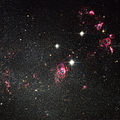
| Die Galaxie UGC 4305 aufgenommen vom Spitzer-Weltraumteleskop. | |
| AladinLite | |
| Sternbild | Großer Bär |
| Position Äquinoktium: J2000.0, Epoche: J2000.0 | |
| Rektaszension | 08h 19m 05,0s [1] |
| Deklination | +70° 43′ 12″ [1] |
| Erscheinungsbild | |
| Morphologischer Typ | Im[1] |
| Helligkeit (visuell) | 11,1 mag[1] |
| Helligkeit (B-Band) | 11,38 mag[2] |
| Winkelausdehnung | 7,9′ × 6,3′[1] |
| Physikalische Daten | |
| Zugehörigkeit | M81-Gruppe, LGG 176 |
| Rotverschiebung | 0,000474 ± 0,000003[1] |
| Radialgeschwindigkeit | (142 ± 1) km/s[1] |
| Hubbledistanz H0 = 73 km/(s • Mpc) | (11 ± 1)e6 Lj (3,48 ± 0,25) Mpc [1] |
| Durchmesser | 25.000 Lj |
| Geschichte | |
| Entdeckung | Erik Bertil Holmberg |
| Entdeckungsdatum | 1950er Jahre |
| Katalogbezeichnungen | |
| UGC 4305 • PGC 23324 • CGCG 331-034 • MCG +12-08-033 • IRAS 08140+7052 • Arp 268 • DDO 50 • Holmberg II • KUG 0814+708 • LDCE 0842 NED002 | |
UGC 4305 = Arp 268, nach ihrem Entdecker auch als Holmberg II bezeichnet, ist eine Zwerggalaxie im Sternbild Großer Bär, die etwa 11 Millionen Lichtjahre von der Milchstraße entfernt ist. Halton Arp gliederte seinen Katalog ungewöhnlicher Galaxien nach rein morphologischen Kriterien in Gruppen. Diese Galaxie gehört zu der Klasse Galaxien mit unregelmäßigen Klumpen. In UGC 4305 soll sich nach neuesten Untersuchungen ein mittelschweres Schwarzes Loch befinden.
Die Galaxie UGC 4305 wurde in den 1950er Jahren vom schwedischen Astronomen Erik Bertil Holmberg entdeckt.
 (c) NASA & ESA, CC BY 4.0Hochaufgelöste Aufnahme eines Teils von UGC 4305 mithilfe des Hubble-Weltraumteleskops
Weblinks
- Schwarzes Loch – Holmberg II Galaxie (PDF-Datei; 259 kB)
- Holmberg II Dwarf Irregular Galaxy
- Arp Atlas of Peculiar Galaxies
- Seligman Arp
Literatur
- Jeff Kanipe und Dennis Webb: The Arp Atlas of Peculiar Galaxies – A Chronicle and Observer’s Guide, Richmond 2006, ISBN 978-0-943396-76-7
- König, Michael & Binnewies, Stefan (2019): Bildatlas der Galaxien: Die Astrophysik hinter den Astrofotografien, Stuttgart: Kosmos, S. 304
Einzelnachweise
Auf dieser Seite verwendete Medien

Holmberg II galaxy.jpg
(c) NASA & ESA, CC BY 4.0
The NASA/ESA Hubble Space Telescope has captured this image of dwarf irregular galaxy Holmberg II. The galaxy is dominated by huge bubbles of glowing gas, which are sites of ongoing star formation. As high-mass stars form in dense regions of gas and dust they expel strong stellar winds that blow away the surrounding material. The cavities are also blown clear of gas by the shock waves produced in supernovae, the violent explosions that mark the end of the lives of massive stars.
(c) NASA & ESA, CC BY 4.0
The NASA/ESA Hubble Space Telescope has captured this image of dwarf irregular galaxy Holmberg II. The galaxy is dominated by huge bubbles of glowing gas, which are sites of ongoing star formation. As high-mass stars form in dense regions of gas and dust they expel strong stellar winds that blow away the surrounding material. The cavities are also blown clear of gas by the shock waves produced in supernovae, the violent explosions that mark the end of the lives of massive stars.
Holmberg IISST (rotated).jpg
Holmberg II / UGC 4305
Holmberg II / UGC 4305